

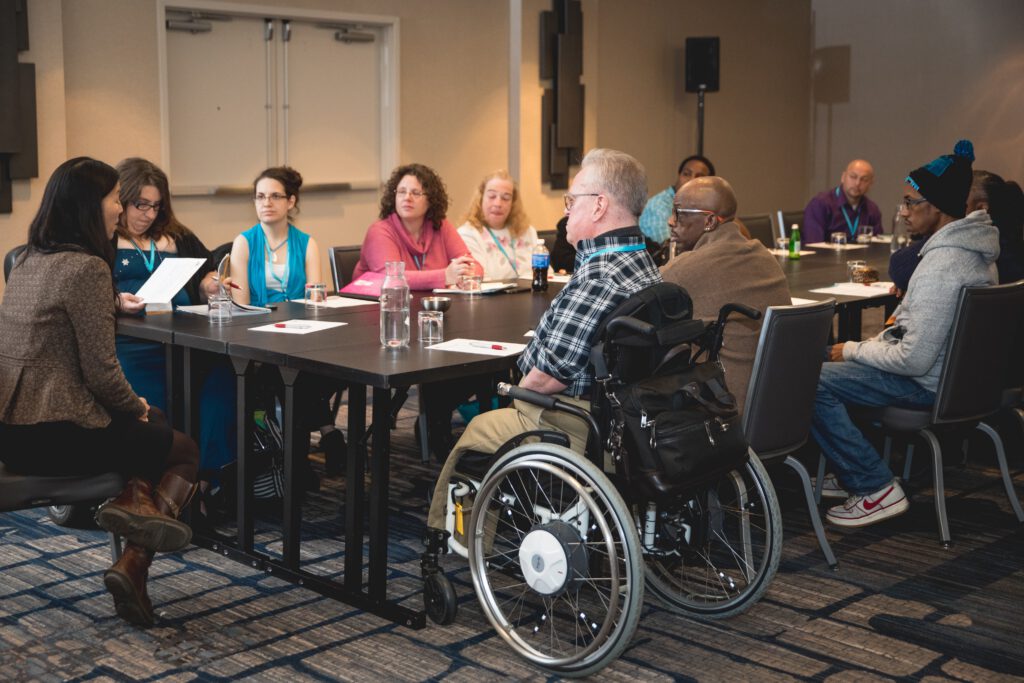
The organization provides training and capacity building that equips PWLE for their roles and advances their personal goals.
- How are we ensuring that PWLE have the necessary skills and knowledge to contribute fully and confidently to the work we are doing together?
- How are we investing in the broader personal and professional development of PWLE beyond the scope of their immediate engagement roles?
- Focus on mutual benefit. Training and capacity building opportunities can:
- Equip PWLE for the work by providing the basic knowledge and skills that they need for the work you are doing together
- Support the long-term personal and development goals of PWLE as leaders and advocates.
- Utilize a diverse set of trainers. Training and capacity building opportunities can be led by staff who work with PWLE, colleagues from departments across the organization, external partners and professional trainers, and PWLE themselves.
- Prioritize hands-on learning. Sometimes the difference between having an opportunity to ‘do’ and an opportunity to ‘learn’ is simply a matter of having the time and support necessary to build new skills, ask questions, and reflect on the experience. Making space for hands-on, experiential learning can be a surprisingly low-lift way of strengthening your work and engagement with PWLE.
Examples of training and capacity building opportunities include:
- Onboarding and orientation training for PWLE who are stepping into roles on governance boards, advisory committees, and project teams including:
- History of the organization and the advisory committee
- Overview of the organization and advisory committee’s structure – including where the advisory committee is situated within the organization
- Explaining what their roles and responsibilities are, and what the organization’s expectations and responsibilities are
- Group norms and agreements
- Any relevant background or context about key issues the committee or project team is working on
- Research trainings on study design, methods, ethics and the research life cycle
- Policy and advocacy training on legislative processes, community organizing skills, systems change, and specific policy domains (e.g., Medicaid).
- Storytelling and public speaking coaching
- Professional skills workshops on topics like conflict resolution, facilitation, understanding learning/working styles, and computer skills
- Observational and hands on learning including:
- Conference attendance and presentation opportunities
- Opportunities to shadow and support different committees, teams, and projects within the organization
- Leadership development such as chairing committees and mentoring peers
- Professional growth support such as writing professional bios, developing resumes or getting professional headshots
- History of the organization and the advisory committee
National Health Care for the Homeless Council prioritizes training and capacity building opportunities for PWLE.
“There are a couple of PWLE that we work with that are interested in research, and so we’ve brought them into our research committee. We actually have several consumers that regularly attend, which is really exciting, so they can hear about some of the recent research and ask questions. We’re trying to build that out into something slightly more formal and really think about professional development and capacity building around research. Some of our colleagues in our research team approached us about hosting a session to just talk about consumer engagement and research, and we’ve helped them put together a glossary of terms – for instance, to describe what is qualitative versus quantitative research. Because if you’re a PWLE in a meeting with a researcher and they’re throwing all these words at you, here’s what they mean. And so we’re trying to start building some of that out.”
National Health Care for the Homeless Council also developed this online course to assist Consumer Leaders with taking active and impactful Consumer Engagement roles: Consumer Engagement for Consumer Leaders – National Health Care for the Homeless Council