
Background & Methodology
Background: INSPIRE
INSPIRE (Initiating National Strategies for Partnership, Inclusion, and Real Engagement) is a national partnership of organizations and people with lived experience (PWLE) working together to advance the practice of authentic community engagement (CE).
Our strategic roadmap, informed by conversations with over 300 people doing CE across the country, includes a recommendation to support professionals leading community engagement (CE) by providing step-by-step guidance for real-life applications of CE practices.
Definitions
Early in our work, we recognized a core challenge: there is no shared, commonly understood definition of “community engagement.” To ground our approach, the INSPIRE team developed this definition: “Community engagement is the different ways in which healthcare organizations can reach out to, engage, and partner with people with lived experience (PWLE), with the goal of working together to improve healthcare and achieve positive health outcomes.”
To emphasize the central purpose of this work, and to address ongoing variation in how “community engagement” is used and understood, the project team uses the term “engaging PWLE” throughout this resource. This phrasing offers greater clarity and specificity about who is involved and what the work aims to achieve.
Project Design and Approach
To meet the need for actionable guidance that helps organizations build meaningful partnerships with PWLE, a subset of the INSPIRE team: Camden Coalition; the Center to Advance Consumer Partnerships (CACP); the Institute for Patient- and Family-Centered Care (IPFCC); and two experts with lived experience, Stephanie Burdick and Rebecca Esparza, collaborated to identify and document concrete practices that support authentic partnerships with PWLE across diverse healthcare and community settings.
Each partner played an integral role in project planning, data collection, analysis, and finalization. The project was intentionally designed as a co-production effort, ensuring that PWLE served as co-contributors throughout all phases of the work, from research design to decision-making.
Methodology
The project team used a data collection approach rooted in implementation science principles. Our methods integrated qualitative techniques (individual and group interviews, focus groups, and document review) with collaborative analysis to document and translate key features of successful CE initiatives.
The original plan was to identify and describe best practices for building partnerships between organizations and PWLE using “practice profiles,” a common implementation science tool for supporting the adoption of evidence-based practices. As the project progressed, however, the team recognized the need for a more flexible resource – one that prioritizes accessibility and practical use across the wide range of contexts in which CE takes place.
Site Recruitment and Selection
In Fall 2024, the project team began recruitment for healthcare organizations to participate as project partners. To ensure representation across organizational types, geographic regions, and community populations, the team disseminated a Request for Applications (RFA) and leveraged the communication networks of the INSPIRE Team and national partners to broaden the reach of the RFA.
Selection criteria prioritized organizations that:
- Demonstrated authentic partnership with PWLE through a formal mechanism (e.g., Patient and Family Advisory Council, Community Advisory Board);
- Represented distinct contexts across healthcare (e.g., health plans, health systems/healthcare providers, community-based organizations providing healthcare services);
- Represented distinct geographic and/or service populations.
Seven organizations were ultimately selected to participate in this project. Final selections were made through a collaborative vetting process involving INSPIRE team members, including PWLE.
Participating organizations:
- CommonSpirit Health
- Community Care
- Community Health Plan of Washington
- HealthierHere
- National Health Care for the Homeless Council
- Pediatrics Northwest
- Stanford Health Care
Data Collection
For each participating organization, the team conducted a multi-phase data collection process consisting of:
- Discovery Phase
The team engaged with each organization to understand their context, history, and approach for building partnerships with PWLE. This phase included exploratory calls and a review of key documents, such as advisory committee charters, program descriptions, evaluation reports, communication tools, meeting agendas/minutes, and publications related to the organization’s work with PWLE.
- Semi-Structured Interviews
The team developed unique interview guides for each organization, focusing on implementation processes, facilitators and barriers to success, lessons learned, and evaluation and measurement.
To gain a “360 degree” perspective, the team conducted in-depth individual and group interviews with multiple stakeholder groups, including:
- Frontline staff leading working with PWLE
- Department and executive leaders
- PWLE who members of the organization’s advisory committee(s)
All interviews were recorded (with participant consent), transcribed, and reviewed by interviewers to ensure accuracy.
Data Analysis
The team synthesized data across all participating organizations and generated queries designed to address the project’s guiding questions. Our analysis used a mixed-method approach combining qualitative review with the AI tool NotebookLM to identify emerging themes.
Analysis was an interactive sense-making process in which we identified and organized key practices for effective community engagement. In this process, the team considered organizational frameworks; CACP’s existing engagement framework, which focuses on “domains of engagement,” provided the foundational structure for organizing our key practices into the below INSPIRE framework.
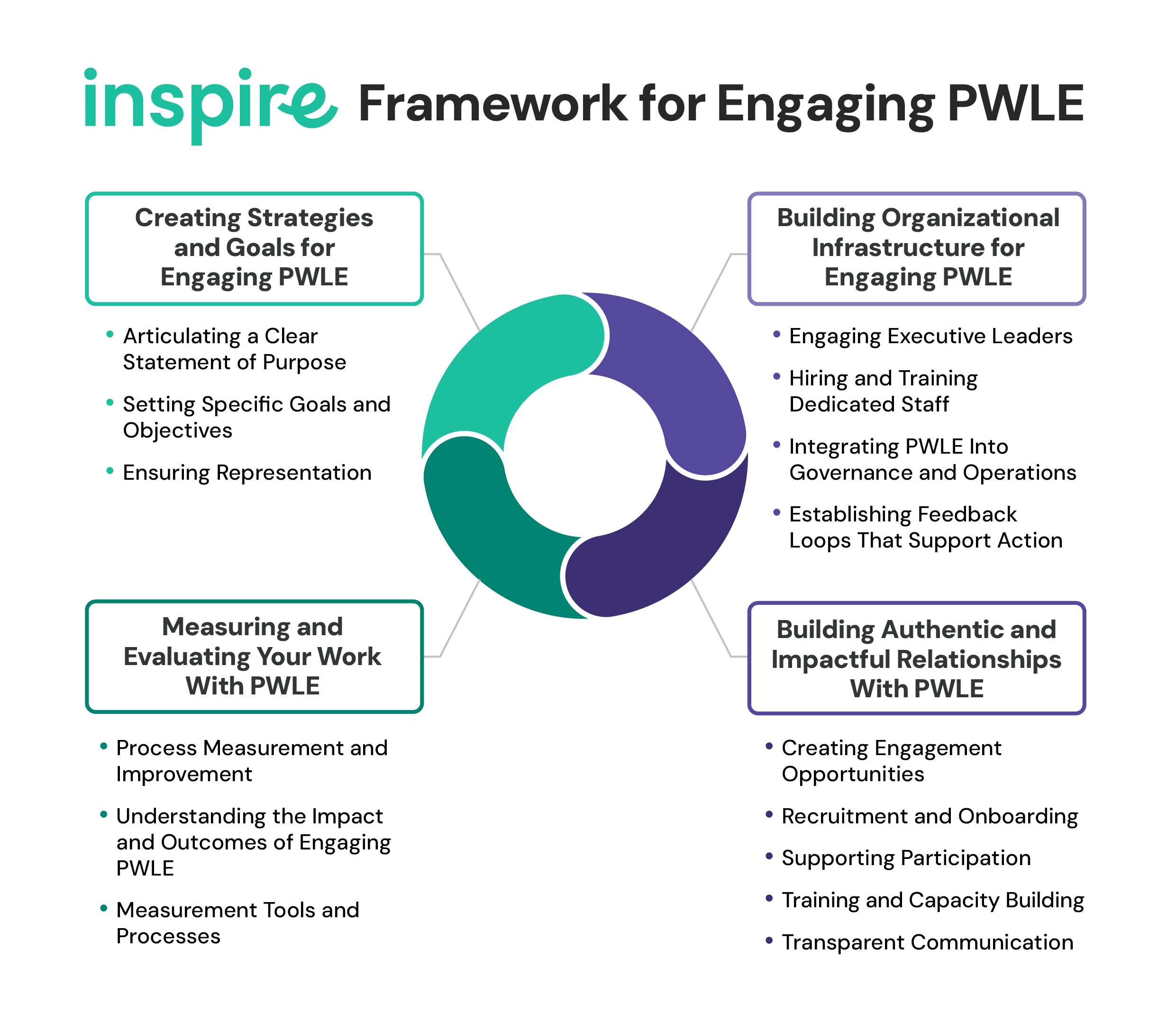
Through an iterative process, we distilled a list of specific practices that contribute to authentic and sustainable partnerships with PWLE across diverse organizational contexts.
Resource Development
In developing this resource, the team reviewed existing guides and toolkits designed to support organizations in engaging PWLE. A key goal was to provide frontline staff with actionable guidance by directing them to the most relevant information for their needs.
As a result, the team developed a brief assessment that offers tailored recommendations and links to our “Practice Library” containing detailed implementation information. The draft version of this product was refined through a collaborative vetting and consensus process, including internal review by the project team and external validation by the INSPIRE Core Team and participating organizations.
Acknowledgements
The team is deeply grateful to the staff and advisory committee members at the seven participating organizations who generously offered their time, insights, and expertise, and to the Robert Wood Johnson Foundation for their support of this work.