
People with lived experience (PWLE) bring critical insight to the work of transforming health care systems. You know what works, what’s not working, what’s missing, and what really makes a difference because you have lived it. When organizations invite you to participate as advisors, reviewers, storytellers, or co-designers, they’re investing in better care, access, equity, and outcomes.
It is also an investment for you in terms of your time, energy, and expertise. Organizations that wish to engage you have a responsibility to ensure that their practices are respectful, inclusive, responsive, and provide value to you as a participant.
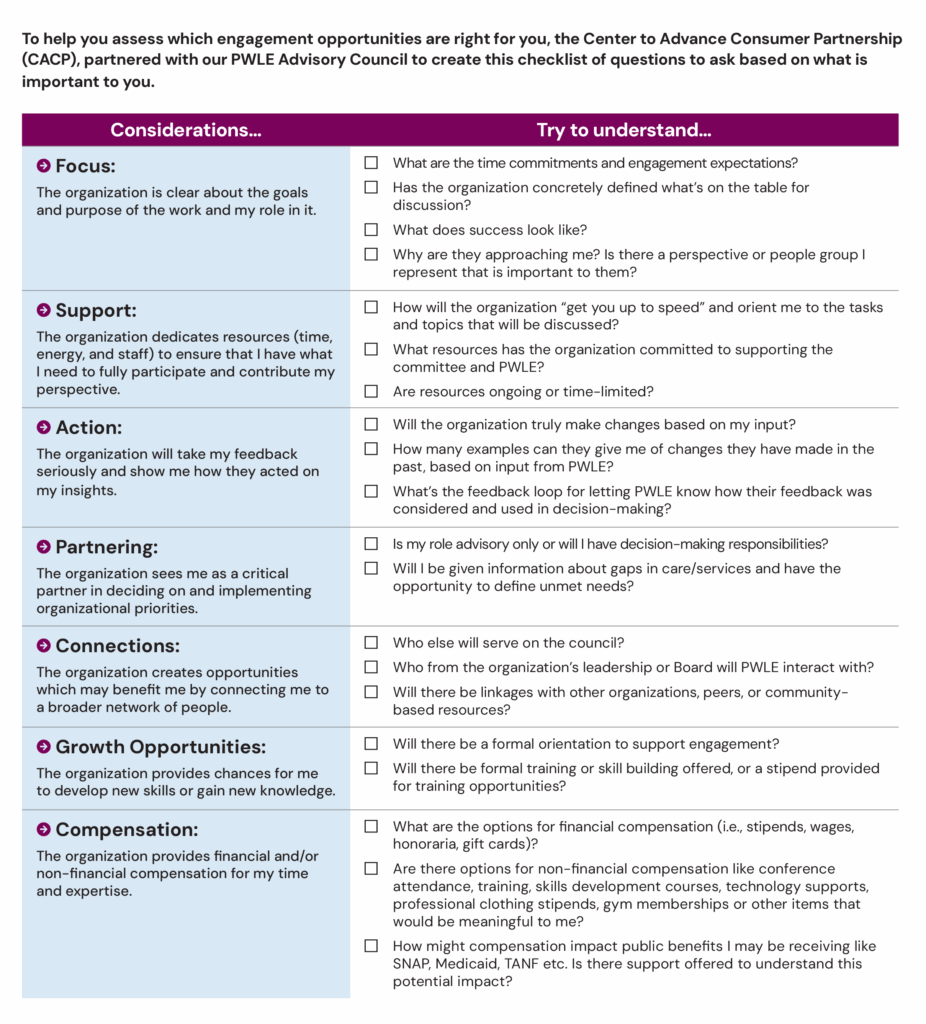
A Few More Notes on Compensation
Reimbursement covers out-of-pocket costs like transportation, mileage, childcare, parking, and lodging (if the engagement spans multiple days). It is not income and should never be reported as such. Organizations should proactively cover these types of expenses.
Navigating the Benefits Cliff
PWLE who contribute their expertise and time to health care improvement efforts may be recipients of federal and/or state benefit programs to manage complex health, caregiving, or financial needs. Eligibility to receive public benefits is strictly tied to income and asset thresholds. Additional income can jeopardize a person’s eligibility for public benefits or reduce their monthly support. This is referred to as “the benefits cliff.”
The benefits cliff is not the same for everyone. Each person’s income limit depends on the state where they live, family situation, and combination of benefits that they access, making this issue especially hard to navigate.
What you can do:
- Know what you receive. Understand whether you or your family receive public benefits.
- Learn the rules. For each state and federal public benefit you receive, know the dollar amount, or income threshold, that would lead to a reduction or loss of benefits.
- Seek support. Case managers, social workers, and local benefits navigators may be able to help you assess the impact of receiving compensation based on your current benefits.
- Track your income. Set up a system to only earn enough money from all sources to keep your income below public benefit program thresholds. Monitor this income bimonthly.

About CACP
CACP is a nonprofit working to improve the health care system by working directly with health sector organizations around the country, helping them realize the value of every voice and put the voices of people with lived experience at the heart of strategy and operations.
We know people with lived experience belong where decisions are made. We envision a health care system that recognizes and values the lived experiences of individuals with complex health and social needs, fosters deep collaboration between experts by experience and experts by training, and builds trust while sharing power to co-design solutions that improve outcomes, enhance experiences, and manage costs.
This guide was co-designed with CACP’s PWLE Advisory Council and reflects their lived experience navigating compensation and engagement. We are grateful for their decades of insight, leadership, and commitment to improving health care systems for everyone.
Check out the companion piece for healthcare organizations here.